

How Much AI Is Enough in Retail Planning?
Retailers don’t need more AI. They need the right amount for each decision, on a platform that sees the whole business and never waits for a nightly batch.
The Question Has Changed
There has been a lot of hype about AI in retail; every vendor promises and every retailer wants it. The results are paltry in comparison.
Fewer than one in ten supply chain organizations have scaled AI pilots into enterprise-wide operations, according to research by GEP and the University of Virginia’s Darden School of Business (GEP). PwC’s 2026 Digital Trends in Operations Survey found that just 34% of organizations are scaling AI across the enterprise, and 89% say their tech investments have fallen short of expectations (PwC).
So the better question is no longer whether a system has AI. It is how much AI each decision needs, and who stays in charge.
Gartner has warned of “agent washing” in supply chain planning, where conventional automation is relabeled as agentic, and says “vendors claiming end-to-end autonomous supply chain planning before 2027 are overstating” (Gartner).
Retail makes this question urgent. McKinsey and EuroCommerce describe retail as sitting at “the intersection of high decision density, structurally thin margins, and labor-intensive operations” (McKinsey). Every week, a retailer makes a huge number of small decisions and a handful of big ones. Treating them all the same is where most AI programs go wrong.
Match the AI to the Decision
Not every decision deserves the same artificial, or human, intelligence. Two things decide how much a decision should be automated: how often it happens, and what a wrong call costs.
- Automate the everyday. Store replenishment and store-to-store transfers happen constantly, and a single wrong order is cheap to fix. These should run on their own, inside limits your planners set: order value, quantity change and exception thresholds.
- Recommend on the high stakes. Purchase orders, initial allocation and pre-season buys tie up cash and supplier capacity. Here the system should do the heavy lifting and the planner should approve.
- Inform the strategic. Merchandise financial plans, open-to-buy and assortment strategy shape the season. AI-driven forecasts and scenarios should inform the call, but people should still make it.
“Only simple, explainable and accepted planning decisions are suited for autonomy.”
Gartner Supply Chain Symposium/Xpo 2026, Barcelona (source)
Gartner also says leaders should “treat autonomous planning as a decision strategy, not a technology rollout” (Gartner).
Purchasing shows how this works in practice. In Dataviva, Inbound Planning builds each purchase order from the forecast, scales it to the right quantities and fills the container. The planner sees a finished order, checks it against the limits they set, and approves it.
This is what we mean by AI-Led Planning: AI leads the work, and people set the limits and make the calls that matter.
To Route a Decision, You Have to See All of Them
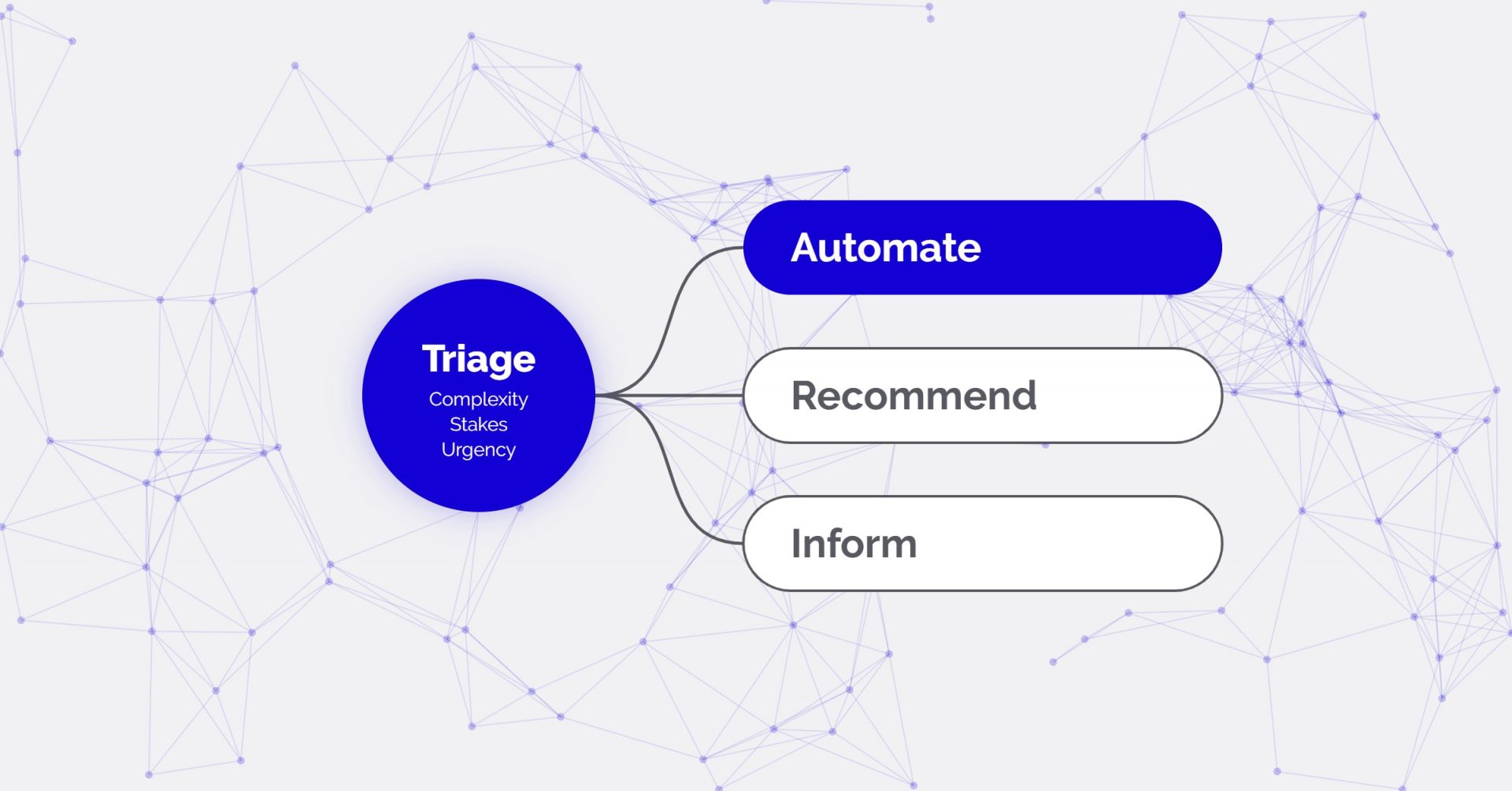
Matching AI to decisions sounds simple. In practice it means ranking every decision by three things: how complex it is, what is at stake, and how urgent it is. Urgency matters as much as the other two: a late truck at noon is worth more attention than a perfect forecast for next month.
Once ranked, each decision gets routed. Simple work goes to automation; high-stakes work goes to a planner as a recommendation; and strategic work goes to the people who own the plan.
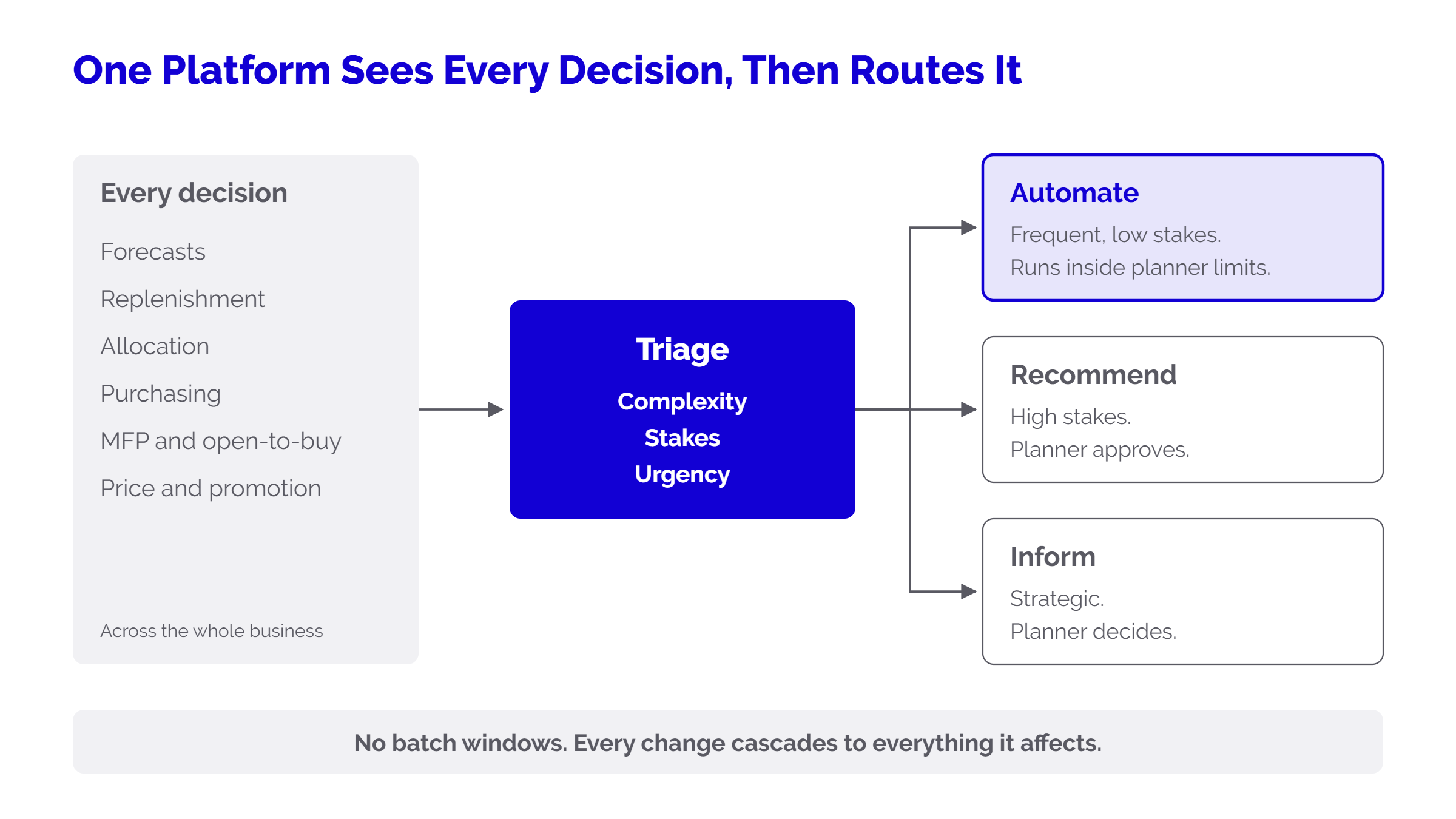
But you can only rank what you can see. If forecasting, replenishment, allocation, purchasing, financial planning and pricing live in separate systems, no one can weigh a transfer against a markdown or a rush purchase order. Each tool automates its own slice and passes the problem along.
A PwC survey found that AI initiatives often start inside single business units, which fragments ownership. PwC calls on leaders to “de-silo decision-making” (PwC). McKinsey and EuroCommerce found that fragmented use cases “improve individual productivity but rarely create enterprise value” (McKinsey).
Dataviva plans and executes forecasting, replenishment, allocation, purchasing, financial planning, assortment and pricing on one platform. That single view is what makes it possible to triage across the whole business.
Automation Is Only as Good as the Plan It Acts On
Automation acts on the current plan. If that plan refreshes in a nightly batch, automated (and human!) decisions spend the whole day acting on yesterday’s numbers. The more you automate, the more that lag costs.
Dataviva has no batch windows. Plans recalculate as events happen. But speed alone is not enough. You should again take a holistic view across the business:
- Update the affected plan. A sale, a delay or a data change updates the forecast and order plan for the items it touches. Many systems can claim some version of this.
- Follow the change wherever it goes. When an update spreads, the calculation widens to everything it affects.
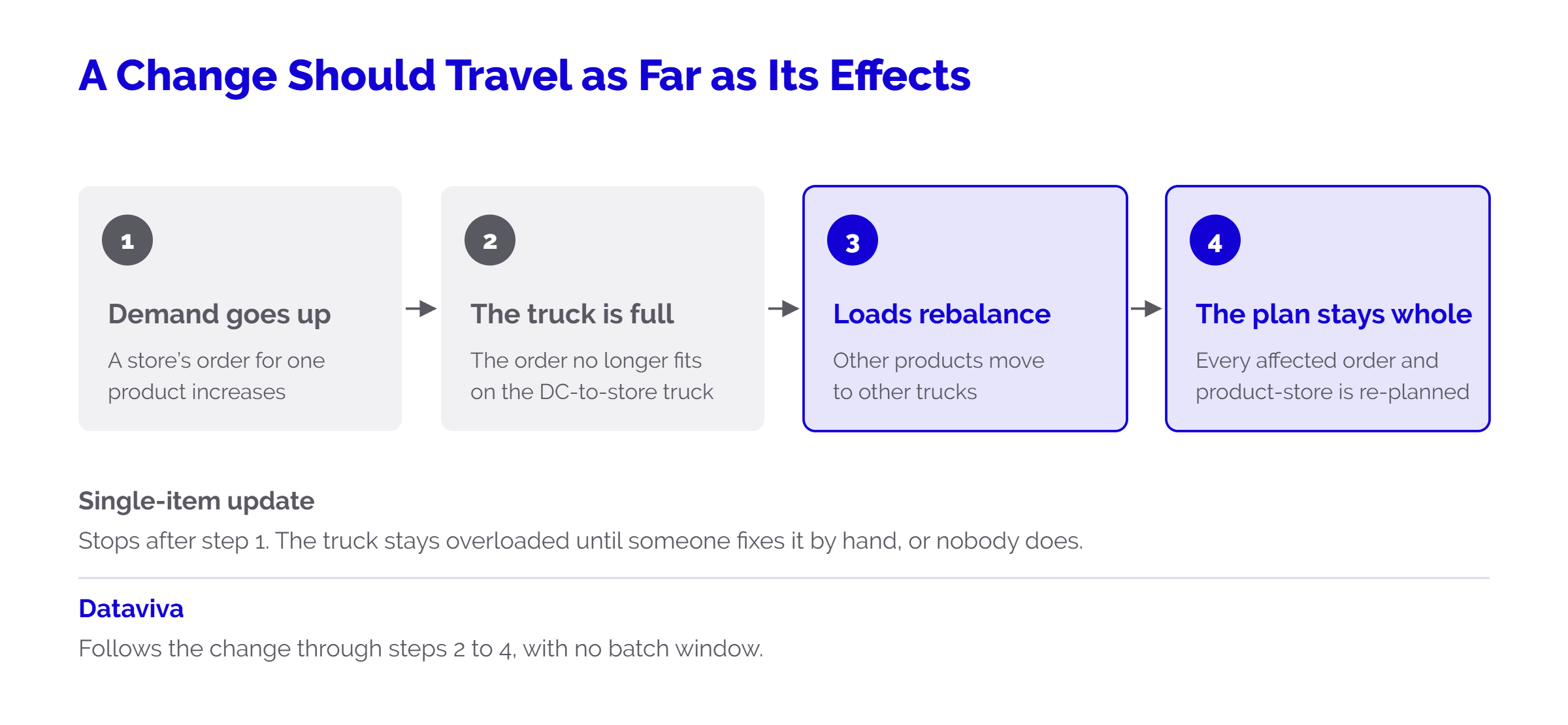
Take a simple case. A store’s order for one product goes up. That order no longer fits on the truck from the distribution center to that store. A system that re-plans only that one product at that one store leaves the truck overloaded. Someone fixes it by hand, or nobody does.
Dataviva widens the calculation instead. It moves other products to other trucks to make room, then re-plans every order and every product-store combination the move affects. The plan stays whole, so the next automated decision acts on numbers that are actually true.
This is what we mean by The Retail Nervous System: sense a change, then respond everywhere it matters, not just where it started.
Planners Should See Why
Planners override what they don’t understand. A recommendation with no reason behind it gets second-guessed, and an automated order nobody can explain gets switched off. That is why explainability, not more automation, is often what unlocks the next step.
Note the word “explainable” in Gartner’s test for autonomy above. A decision can only be handed to the system once the people responsible can see how it was made.
Dataviva shows planners why each order and recommendation was made. Every automated decision is logged, traceable and reversible. A planner looking at a purchase order will see what drove it, check it against the limits they set, and undo it if needed. Trust stops being a leap of faith and becomes something the system earns, decision by decision.
Start Where Mistakes Are Cheap
Supply chain leaders agree that autonomy should be earned, step by step. In a 2026 survey by ASCM and the Digital Supply Chain Institute, the average AI adoption score across 13 supply chain functions was 1.94 on a five-point scale, where 5 means autonomous execution without human review (FreightWaves). ASCM’s CEO said AI’s decision authority should grow only as confidence in it grows.
That is the right instinct, and it creates a practical path for retailers:
- Start with frequent, low-cost decisions. Store replenishment and transfers are the usual first step. Agree up front what good looks like: service level, override rate, inventory.
- Widen the limits on evidence. Move to the next decision type only when planners keep using the system and results keep improving.
- Give planners their time back for the big calls. Buys, allocation in a shortage, new products and the financial plan.
Harding+ shows where this path leads (Case Study). The cruise retailer has Dataviva generate orders for about 90% of its portfolio without planner touch, across 300+ shops on 75+ ships. Separately, it has cut out-of-stocks by 60% on key lines.
Measure success on inventory, service and working capital, not on headcount. The goal is better decisions, not fewer planners.
Five Questions to Ask Any Planning Vendor
- Which decisions do you automate, and which do you only recommend? A good answer names decisions, not features.
- Who sets the limits, and can planners see why? Your planners should control the guardrails (order value, quantity change, exception thresholds) and see the reason behind every automated decision.
- When did your automation last see fresh numbers? If the answer involves a nightly batch, your automation acts on yesterday.
- If one store order changes and the truck no longer fits, what else gets re-planned, and when? This separates fast updates from a plan that stays whole.
- Will you tie the contract to outcomes? Adoption, override rate, forecast value-add, inventory and service. Dataviva reports these from the product and will put them in the contract (Why Us).
The right amount of AI is a decision-by-decision question. Answering it takes a platform that sees the whole business, recalculates as things change, explains its decisions, and keeps your planners in charge. Talk to us about where your first automated decision should be (See a Demo).
Sources
- GEP and University of Virginia Darden School of Business, The Supply Chain AI Readiness Report
- PwC, Insights from PwC’s 2026 Digital Trends in Operations Survey, 10 Sep 2026
- McKinsey and EuroCommerce, Rewiring retail in Europe: The AI imperative, 10 Jun 2026
- FreightWaves, Workforce gaps keep supply chain AI stuck in pilot mode, 23 Oct 2026, reporting ASCM and DSCI, The People Paradox in Supply Chain AI Integration, 14 Oct 2026
- Gartner, Gartner Warns of Agent Washing Risks in Supply Chain Planning Technology Market, 20 May 2026
- Gartner, Gartner Supply Chain Symposium/Xpo 2026 Barcelona: Day 2 Highlights, 19 May 2026
Related Articles

Dataviva in the 2026 Gartner® Market Overview for Retail Assortment Management, Short Life Cycle
Retail, Gartner, Assortment Planning
Dataviva named an Example Vendor in the 2026 Gartner® Market Overview for Retail Assortment Management Applications: Short Life Cycle Products
read
Dataviva in the 2026 Gartner® Market Guide for Retail Forecasting, Allocation and Replenishment, Short Life Cycle
Retail, Inventory Planning, Forecasting, Gartner, Supply Chain
Dataviva named in the 2026 Gartner® Market Guide for Retail Forecasting, Allocation and Replenishment Solutions: Short Life Cycle Products
read
Dataviva in the 2026 Gartner® Market Guide for Retail Forecasting, Allocation and Replenishment, Long Life Cycle
Supply Chain, Retail, Inventory Planning, Forecasting, Gartner
Dataviva named in the 2026 Gartner® Market Guide for Retail Forecasting, Allocation and Replenishment Solutions: Long-Life-Cycle Products
read
Automating Purchase Orders: Helping Enterprise Buyers Work Smarter
Retail Planning Platform, Purchase Orders, Inbound Planning & Execution
Atlanta, Georgia, 04 November 2025 At Dataviva, we’ve worked alongside large enterprises for years, implementing planning and supply chain solutions. And in almost every deployment, one pain point surfaced again and again: purchasing. Creating and approving purchase orders (POs) is often slow and manual, sitting awkwardly between financial planning and day-to-day execution. For buyer teams…
read